
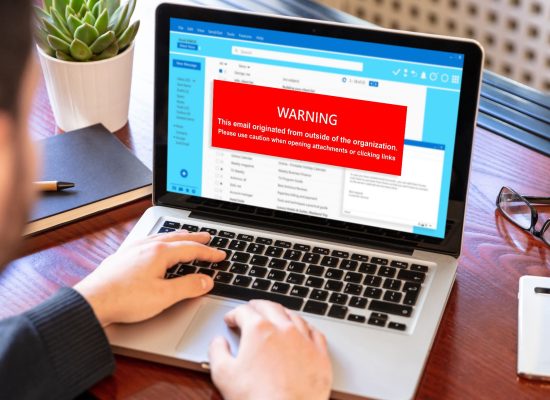
Phishing remains the most common and disruptive cyber attack affecting UK organisations – but as we move through 2026, the scale, sophistication and impact of these attacks are accelerating rapidly. AI-driven impersonation, deepfake audio, supply-chain spoofing, and compromised accounts are pushing phishing into a new era – one that many businesses are still unprepared for.
Here’s the latest evidence on why phishing has become the UK’s largest number-one threat, and why not is the time for organisations to take action.
Phishing in 2026: The Latest UK Landscape
The 2025 UK Cyber Security Breaches Survey shows that phishing remains the dominant cyber threat. According to the latest dataset:
- 85% of UK businesses that experienced a breach were hit by phishing
- Phishing also affected 86% of impacted charities
- Across the UK, 612,000 businesses identified cyber breach in the last 12 months, with phishing making up the majority of those attacks.
Despite this, overall identification of phishing attacks actually fell among micro and small businesses – not because attacks decreased, but because attacks have become harder to detect, particularly with AI-powered impersonation.
A separate analysis confirms that phishing remains the most significant threat:
- Phishing dominance continues, with 85% of breached businesses experiencing attacks, and AI-powered impersonation now ‘’mainstream’’ in the UK.
- Attacks have become increasingly disruptive – 65% of organisations rate phishing as their most time-consuming incident type
Meanwhile, global threat intelligence shows a steep rise in volume and sophistication:
- A 17.3% spike in phishing emails was recorded over six months (Sep 2024–Feb 2025)
- 82.6% of phishing emails now use AI, making them harder to spot and more personalised than ever before (a 53.5% year-on-year increase)
- Over 57% of phishing emails come from compromised accounts, not external senders, making them far more convincing
This combination – rising volume, increased realism, and compromised user accounts is reshaping the threat landscape.
Why Phishing Is Becoming Even More Dangerous In 2026
Even as some attack types shift – like the rise in website defacement targeting UK organisations in 2025, phishing remains the most effective method for attackers to gain initial access.
AI is turbocharging
According to the NCSC, AI will dramatically increase the scale, speed, and sophistication of social engineering attacks between now and 2027. Attackers can now generate:
- Polymorphic phishing emails that rewrite themselves
- Voice-cloned phone calls (vishing)
- Deepfake video impersonation
- Targeted spear-phishing that mimics writing styles
This automation means attackers can carry out campaigns that look human, without human effort.
Supply-chain compromise is rising
With 11.4% of phishing attacks now originating from within a supply chain, trust relationships are being weaponised.
Your customers, partners and even job candidates may unknowingly be the source of an attack.
Compromised accounts make detection harder
Over half of phishing emails now come from legitimate but compromised accounts — not spoofed domains, making them almost impossible for staff to identify without additional controls.
New starters and busy teams are prime targets
Research shows new staff typically receive their first phishing email within three weeks of joining a company.
Attackers deliberately target moments of onboarding vulnerability
Why Phishing Defence Needs to Change in 2026
Traditional email filtering and staff awareness alone are no longer enough.
Modern phishing attacks bypass native email tools and secure email gateways at alarming rates – as shown by KnowBe4’s analysis of real-world bypass events.
In 2026, effective phishing protection requires:
- Continuous security awareness training
- Real-time threat detection (MDR) for credential misuse
- Password managers to eliminate weak/reused passwords
- Dark web monitoring to identify exposed credentials
- Phishing-resistant MFA
- Zero-trust access controls
- Cloud configuration monitoring
This aligns with guidance from the NCSC and leading cyber-insurers who warn that traditional perimeter models are no longer sufficient.
Why Businesses Must Act Now
Phishing isn’t just rising — it’s evolving faster than most organisations can keep up with.
The data is clear:
- It remains the no.1 cause of UK breaches (85% of incidents)
- AI is making attacks more personalised, more convincing, and harder to detect
- Compromised accounts and supply-chain intrusions are creating new blind spots
- Phishing is now the starting point for ransomware, fraud, cloud breaches, and identity attacks
Businesses that continue relying on outdated, email-only defences are increasingly exposed.
The organisations that thrive in 2026 will be those that adopt layered, proactive controls, and treat phishing not as an occasional nuisance, but as a constant, evolving threat that requires continuous defence.